
22 May 2026
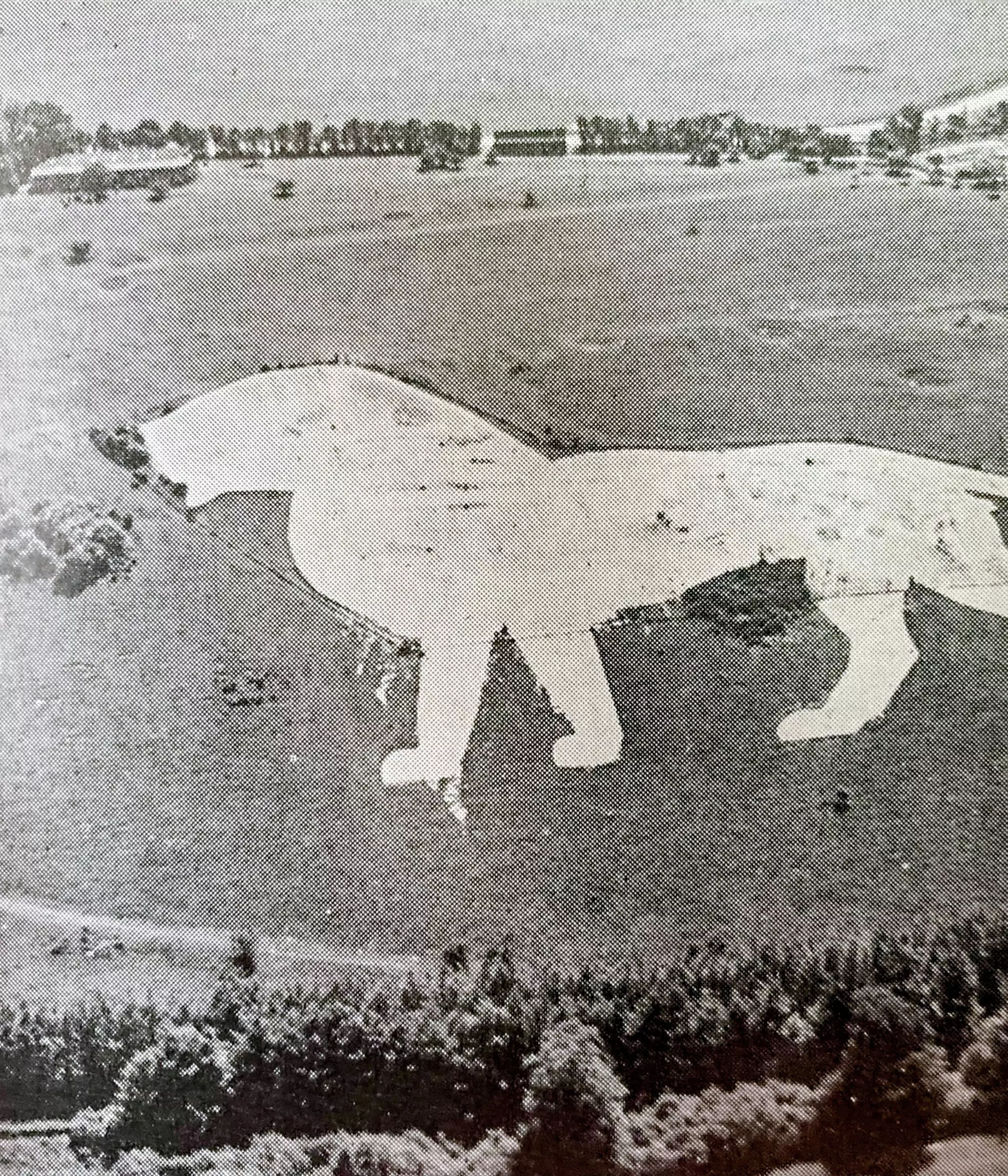
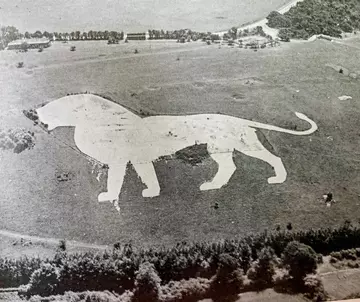
The White Lion of Whipsnade is one of Britain’s most recognisable chalk figures - a bold landmark, stretching 480 feet across Bison Hill, and a symbol of the deep connections between the Zoo and its surrounding community.
Unveiled in 1933, the White Lion was unlike anything seen before: part advertisement, part artwork, and entirely unmissable. Visible for miles across the countryside and from the air, it told the world that ZSL’s newest conservation zoo - Whipsnade Zoo - was open and that it would be an ambitious place of wonder and discovery.
The White Lion has since become more than a landmark. A witness to history - camouflaged during the Second World War to keep it hidden from enemy aircraft, it’s been loved, restored and rechalked by generations of visitors and local volunteers.
The story of its creation is testament to ZSL’s ability to bring together people with diverse skills and passions in the name of conservation and education - something we still do today.
Here, ZSL member Rod Carden-Lovell reveals how his grandfather and a team of local families brought the White Lion to life.
How was the Whipsnade White Lion created?
My grandfather, Hugh Simmons, was a man of many talents. He came from a long line of flour millers, his family owned windmills and watermills across Dunstable, Leighton Buzzard, and Edlesborough, selling flour under the family brand name SNOWWIS (an upside-down play on the family name).
Life changed for him during the First World War. Wounded in battle in France, he returned home with shrapnel lodged too close to his heart for surgeons to safely remove. It meant he could no longer continue in the milling business.
From flour to fur & feathers
Through his wife, Ellen Simmons (née Bates) - whose family were farmers in Whipsnade Village - Hugh found his way to Whipsnade Zoo, where he became first a Foreman, then the Superintendent. Ellen’s brother, Phillip Bates, was already an Overseer at the Zoo, and during the Second World War, the Bates family farms along with other local farms played a vital role, supplying animal feed to keep the Zoo running through wartime shortages.
Beyond his work at the Zoo, my grandfather had a deep love of astronomy. He was a Fellow of the Royal Astronomical Society, part of a group known as “The Eight” - amateur astronomers who collaborated to build telescopes capable of photographing the planets. Their ground-breaking work was published in astronomical journals.
It was this passion - and those very telescopes - that played a surprising role in the creation of the White Lion.


Hugh's telescope is still in the family's possession today
A bold idea takes shape
In 1931, the idea for the Lion was put forward as a bold way to advertise the Zoo. It was designed by R. B. Brook-Greaves, who was a friend of my grandfather. He was a talented architect best known for his creation of 3D drawings using isometric projection for accuracy. Among his best known images were of St. Pauls Cathedral and London Zoo. This technique helped with the creation of the Lion, which would stretch an incredible 480 feet across Bison Hill. Work began that year, with the hill’s surface painstakingly cleared to reveal the natural white chalk beneath.
Telescopes and tea towels
Ensuring the Lion’s massive proportions looked correct from the ground - and the sky - was no easy task. My grandfather would set up one of his telescopes on Ivinghoe Beacon, accompanied by a workman.
Another of his telescopes was positioned on the top of Bison Hill, sometimes manned by his brother-in-law Phillip. Using a system of flag signals, they would communicate adjustments back and forth to perfect the outline. Local housewives donated hundreds of white tea towels to create the outline of the Lion, enabling it to be clearly seen through the telescope. Earth removed from down the slope was relocated to create additional height to the hill and lift the the head of the Lion.
The process took 18 months of careful surveying, digging, and adjusting. Finally, at Easter 1933, the White Lion was complete and it immediately became a local landmark.
War and legacy
During the Second World War, the Lion had to be hidden, camouflaged with netting and vegetation so that enemy aircraft couldn’t use it as a navigation aid.
Sadly, my grandfather’s wartime injury finally took its toll, the shrapnel moved and he passed away from a heart attack in 1952. But his legacy - and that of many local families - lives on in that proud chalk figure gazing out from the hill.
Our family’s connection to ZSL didn’t end there. My great-uncle Phillip continued to work at Whipsnade for many years, and my sister, Dawn was even pictured riding an elephant on jigsaw puzzles sold in the Zoo’s shop. As for me - I worked at the Zoo every summer from the age of 13 to 16, and to this day, I remain a member of ZSL.
Whenever I see the White Lion, I think of my grandfather: a miller turned astronomer, turned zoo man, whose telescopes helped bring a local landmark to life.
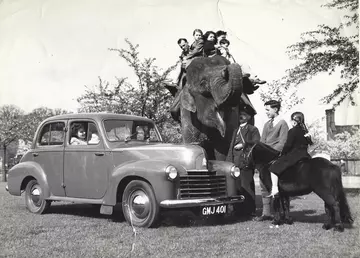
Here, Rod's sister Dawn is on a pony
Whipsnade – a haven for wildlife and people
Rod’s story is one of many remarkable human stories to emerge from Whipsnade Zoo. During the Second World War, as Britain braced for conflict and London suffered bombings and blackouts, Whipsnade Zoo became a place of safety and resilience - not just for animals, but for people too.
Among the most important chapters in Whipsnade’s wartime history is the story of the Kindertransport children. Following the November 1938 Kristallnacht pogrom in Nazi Germany, a major rescue effort was mounted to bring Jewish children to safety in Britain.
Between 1938 and 1939, approximately 10,000 children were brought over from continental Europe. Some of these children found temporary sanctuary at Whipsnade, where they lived with staff families and helped care for the animals. Recollections from the time describe how they found comfort and purpose in this unusual setting, forging bonds with zookeepers and animals that left lasting impressions. For children who had fled unimaginable horrors, nature and the peaceful rhythms of zoo life offered both solace and hope.
Whipsnade also became a sanctuary for animals evacuated from London Zoo during the Blitz, with species from giraffes to parrots moved to the countryside to avoid air raids. The zoo adapted quickly, building enclosures from whatever materials could be sourced and relying on the determination of staff, volunteers, and local communities to keep it running.


Elephant calf Nang Phaya making a splash in the pool
Building the UK’s largest zoo
One such community effort is another little-known but powerful story: the Welsh miners who helped build Whipsnade in the 1920s/30s. During the Great Depression, unemployment in mining communities across South Wales was severe. ZSL arranged for out-of-work Welsh miners to come and assist in the construction of Whipsnade Zoo. They brought with them their families and a wealth of experience in working with stone and terrain and were instrumental in building some of the Zoo's earliest infrastructure, including perimeter walls and roads.
These stories aren’t always visible to visitors wandering the broad paths of Whipsnade today, but they are built into our very foundations.
Visit Whipsnade Zoo
Today, Whipsnade Zoo is the UK's largest Zoo - winners of a Tripadvisor Travellers' Choice Award in 2025 and 2026!
Don't miss our brand new interactive exhibition when you visit, showcasing 200 years of ZSL's history. As you wander around the display, be transported back in time and learn fascinating facts about our rich heritage.